
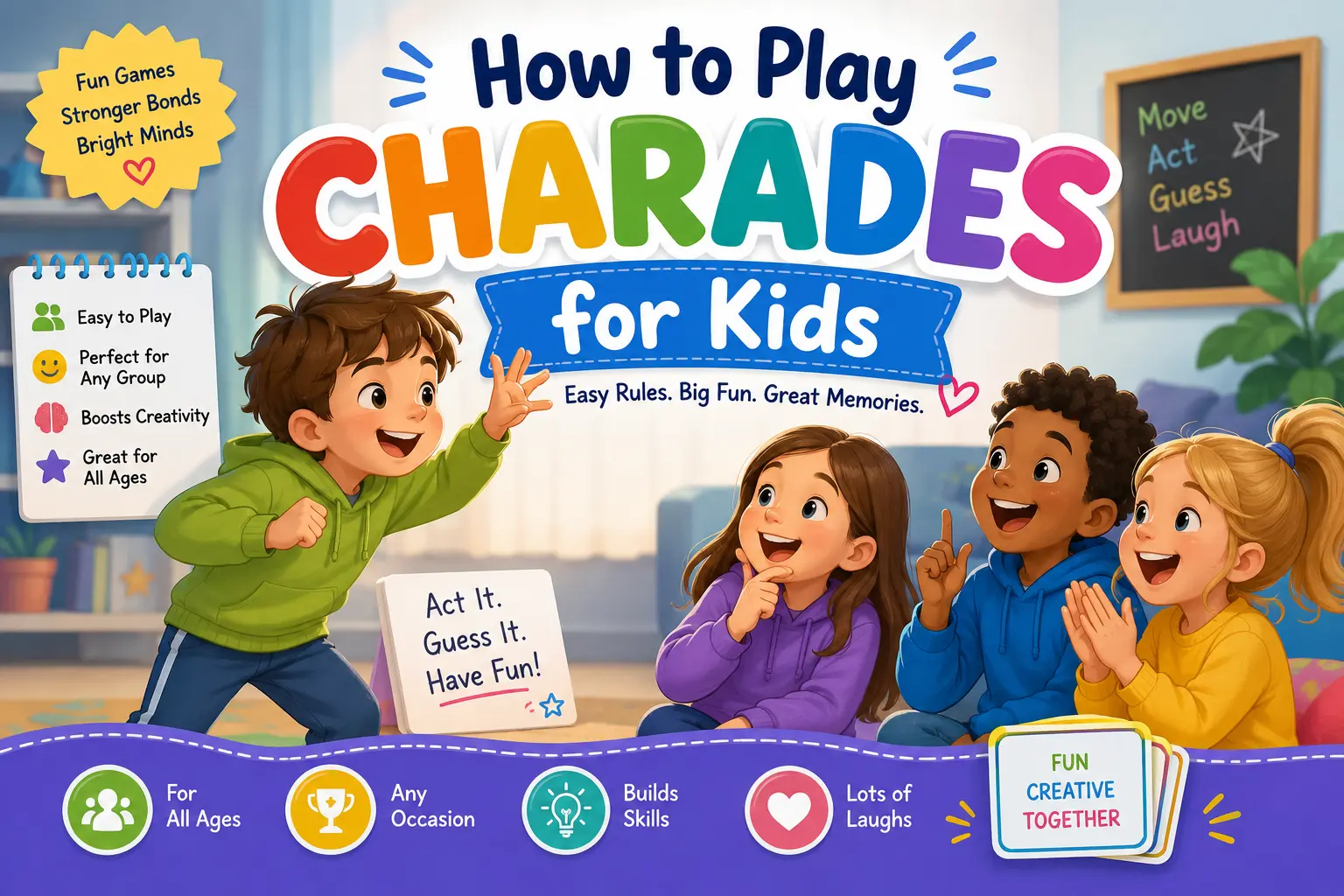
How to Play Charades for Kids: Easy Rules, Tips & Fun Game Guide

Quick Answer:
Charades for kids is a fun guessing game where one child silently acts out a word or phrase while the other players try to guess it before time runs out. Players cannot speak, make sounds, or point to objects. The game is easy to learn, encourages teamwork, and works well at home, in classrooms, at birthday parties, and during family game nights.
What Is Charades for Kids?
Charades for kids is a simple acting game where children use only gestures and body movements to help others guess a secret word or phrase. It is designed with easy, age-appropriate prompts that children can understand and act out without speaking.
Unlike many games that require boards, cards, or expensive equipment, charades can be played almost anywhere. All you need is a list of words, a timer, and a group of players who are ready to have fun.
Children might act like a roaring lion, pretend to brush their teeth, fly like an airplane, or bounce like a kangaroo. Their teammates try to guess the answer before time runs out.
The game is popular because it is easy to learn and keeps everyone involved. It also encourages children to move, laugh, and think creatively while spending quality time together.
Whether you are planning a birthday party, organizing a classroom activity, or looking for an indoor game on a rainy afternoon, charades is an excellent choice.
Pro Tip: Use our Charades for Kids Generator to generate unlimited kid-friendly words in seconds instead of writing your own.
Why Kids Love Charades
Children enjoy games that let them move around, use their imagination, and play together. Charades combines all of these in one simple activity.
Some of the reasons kids love charades include:
- It is easy to understand.
- Everyone gets a turn.
- There are no complicated rules.
- Acting is often funny and exciting.
- Every round is different.
- It works with small or large groups.
- It can be played almost anywhere.
Because every round introduces a new word or action, children stay engaged without getting bored.
Why Parents and Teachers Love Charades
Parents and teachers appreciate charades because it is more than just entertainment. It encourages children to communicate, cooperate, and think creatively while having fun.
When children play charades, they naturally practice skills such as:
- Vocabulary development
- Listening carefully
- Creative thinking
- Problem-solving
- Non-verbal communication
- Teamwork
- Taking turns
- Confidence when performing in front of others
Teachers often use charades as a classroom brain break, vocabulary review activity, or icebreaker because it requires very little preparation.
Parents also enjoy that the game does not require screens or expensive toys.
What You’ll Need to Play Charades
One of the biggest advantages of charades is that it requires very little equipment.
Before starting, gather the following:
👥 Players
Charades works best with 4 or more players, but even two children can enjoy the game.
For larger groups, divide everyone into two or more teams.
📝 Charades Words
You will need words or phrases for players to act out.
Some popular categories include:
- Animals
- Food
- Movies
- Disney Characters
- Sports
- Occupations
- Nature
- Superheroes
- Action Words
Using a Charades for Kids Generator makes choosing words much faster.
⏱ Timer
A timer keeps each round moving and makes the game more exciting.
You can use:
- Phone timer
- Kitchen timer
- Smartwatch
- Stopwatch
- Online timer
We’ll recommend the best timer settings later in this guide.
📄 Paper or Printable Cards (Optional)
Many families enjoy writing words on small pieces of paper and placing them in a bowl.
Another option is to print ready-made charades cards for quick setup.
🏠 Enough Space to Move
Players should have enough room to act safely.
Move chairs, toys, or other objects out of the acting area before starting.
😊 Positive Attitude
Charades is most enjoyable when everyone feels comfortable participating.
Encourage cheering, laughing, and celebrating every player’s effort instead of focusing only on winning.
How to Set Up a Charades Game
Setting up charades only takes a few minutes.
Follow these simple steps before the first round begins.
Step 1: Gather Everyone
Invite your players to stand or sit in a circle where everyone can easily see the person acting.
For larger groups, divide players into two balanced teams.
Try to mix older and younger children so each team has a similar skill level.
Step 2: Choose Your Word Source
Decide how players will receive their words.
You can:
- Use our Charades for Kids Generator
- Print charades cards
- Write words on slips of paper
- Use a mobile app
- Create your own custom word list
For younger children, choose simple words they already know.
Step 3: Pick a Difficulty Level
Not every group needs the same challenge.
Choose a level that matches the players.
| Difficulty | Best For | Example Words |
|---|---|---|
| Easy | Ages 3–5 | Cat, Ball, Apple |
| Medium | Ages 6–8 | Dentist, Bicycle, Pizza |
| Hard | Ages 9–12 | Astronaut, Volcano, Orchestra |
| Expert | Teens & Adults | Invisible, Democracy, Time Machine |
Starting with easier words helps build confidence, especially for first-time players.
Step 4: Decide on a Timer
Choose how long each player has to act.
Shorter rounds make the game faster and more exciting.
Older children usually enjoy quicker challenges, while younger children often need more time.
Step 5: Explain the Rules
Before anyone starts acting, make sure every player understands the basic rules.
Explain that:
- No talking
- No sounds
- No spelling words
- Use only body movements and facial expressions
- Everyone gets a turn
Keeping the rules simple avoids confusion later.
Step 6: Choose Who Goes First
There is no right or wrong way to decide.
You could:
- Draw names from a bowl
- Let the youngest player begin
- Roll a die
- Play rock-paper-scissors
- Choose randomly
After each round, rotate to the next player so everyone participates equally.
Quick Setup Checklist
Before starting your game, make sure you have:
✅ Players ready
✅ Words or generator
✅ Timer
✅ Safe play area
✅ Teams (if needed)
✅ Rules explained
✅ Everyone excited to play
Once these steps are complete, you’re ready to begin your first round of charades.
Ready to Start Playing?
Now that everything is prepared, it’s time to learn exactly how to play charades for kids, including the official rules, scoring methods, timer recommendations, and fun game variations.
In the next section, we’ll walk through each step of a complete charades game so even first-time players can join with confidence.
How to Play Charades for Kids (Step-by-Step)
Once your game is set up, playing charades is simple. The goal is for one player to act out a word or phrase silently while the other players try to guess it before time runs out.
Follow these steps for each round:
1. Choose a Player to Act
Select one child to be the actor for the first round. If you are playing in teams, choose one player from the active team.
The actor secretly chooses a word or phrase from the charades cards, bowl, or generator.
2. Start the Timer
Set the timer before the actor begins.
A common starting time is:
- 90 seconds for younger children
- 60 seconds for most kids
- 45 seconds for older children or advanced players
Once the timer starts, the actor may begin acting out the prompt.
3. Act Without Speaking
The actor uses body movements, facial expressions, and gestures to give clues.
For example:
- If the word is lion, the child might pretend to roar and move like a big cat.
- If the word is swimming, the child might make swimming motions with their arms.
- If the word is ice cream, the child might pretend to lick a cone.
The actor cannot say any words, make sounds, or spell the answer.
4. Let the Team Guess
The other players call out guesses while the actor continues giving silent clues.
Encourage children to guess freely and keep trying until the timer ends.
5. Stop When the Answer Is Guessed
If someone guesses the correct word before time runs out, the team earns a point.
If no one guesses correctly, the round ends when the timer sounds.
6. Switch to the Next Player or Team
After each round, rotate to the next player or team so everyone has a chance to act.
Continue playing for a set number of rounds or until one team reaches the winning score.
Official Charades Rules for Kids
Keeping the rules simple makes the game easier for children to understand and enjoy.
Basic Rules
- No talking while acting.
- No making sounds that give away the answer.
- No spelling words in the air.
- No pointing directly at objects in the room.
- Use only body movements and facial expressions.
- Stay within the time limit.
- Everyone should get a turn to act.
Rules for Fair Play
- Use age-appropriate words.
- Do not choose prompts that are too difficult for younger players.
- Give equal turns to all children.
- Keep the atmosphere supportive and fun.
- Celebrate effort, not just correct guesses.
Optional House Rules
Families and classrooms can adapt the rules to fit their group.
For younger children, you might allow:
- More time per turn
- Simple hints from an adult
- Picture cards instead of written words
For older children, you might add:
- Harder phrases
- Team competition
- Bonus points for difficult prompts
Best Timer Settings by Age
The timer should match the children’s age and skill level. Younger children usually need more time to think and act.
| Age Group | Recommended Time | Difficulty |
|---|---|---|
| Ages 3–5 | 90 seconds | Easy |
| Ages 6–8 | 60 seconds | Easy to Medium |
| Ages 9–10 | 45–60 seconds | Medium |
| Ages 11–12 | 30–45 seconds | Medium to Hard |
If children are struggling, increase the time limit. If the game feels too easy, shorten the timer to make it more exciting.
Scoring Ideas for Kids
Scoring keeps the game organized, but it should remain simple and positive.
Basic Scoring
- Correct guess before time runs out = 1 point
- No correct guess = 0 points
Bonus Scoring Options
For older children, you can make scoring more exciting:
| Achievement | Points |
|---|---|
| Correct guess | 1 point |
| Guessed in under 15 seconds | 2 points |
| Hard difficulty prompt | 2 points |
| Whole phrase guessed correctly | 3 points |
Non-Competitive Option
For younger children or classroom settings, you can skip scoring entirely and focus on participation.
The goal becomes:
- Everyone gets a turn.
- Everyone has fun.
- Everyone practices acting and guessing.
Age-Specific Adaptations
Different ages need different levels of challenge.
Ages 3–5
Use very simple prompts:
- Cat
- Dog
- Ball
- Sleep
- Jump
- Eat
Allow more time and encourage big, easy-to-understand actions.
Ages 6–8
Introduce slightly more detailed prompts:
- Bicycle
- Pizza
- Teacher
- Swimming
- Birthday cake
Children at this age can usually follow standard charades rules with a little guidance.
Ages 9–12
Use more challenging prompts and phrases:
- Astronaut
- Roller coaster
- Playing the guitar
- Treasure hunt
- Ice skating
Older children often enjoy faster timers and team competition.
Tips for Parents and Teachers
Charades works best when children feel confident and included.
Keep the Words Age-Appropriate
Choose prompts children already know. If a word is too difficult, they may become frustrated.
Encourage Big Movements
Remind children to use their whole body and facial expressions. Large gestures make clues easier to understand.
Praise Participation
Celebrate every child who takes a turn, even if the answer is not guessed correctly.
Positive encouragement helps shy children feel comfortable joining in.
Use Categories Children Enjoy
Popular categories include:
- Animals
- Disney characters
- Superheroes
- Food
- Sports
- Movies
- Nature
Using familiar themes keeps children engaged and excited.
Keep Rounds Moving
Avoid long pauses between turns. Having a generator or prepared cards ready helps maintain the energy of the game.
Common Charades Mistakes to Avoid
Helping children avoid these mistakes will make the game smoother and fairer.
- Talking during acting
- Making sound effects
- Pointing directly at objects
- Choosing words that are too difficult
- Forgetting to rotate turns
- Letting one child dominate the game
A gentle reminder of the rules before each round usually prevents most problems.
Quick Recap
To play charades for kids:
- Choose a player to act.
- Start the timer.
- Act out the word silently.
- Let the other players guess.
- Award points for correct guesses.
- Rotate to the next player or team.
Charades is a simple, flexible game that can be adapted for families, classrooms, birthday parties, and children of different ages.