15 Differences Between Democrats and Republicans (Updated with 2025 Polling)

Understanding the real differences between Democrats and Republicans in 2025 is essential for anyone trying to make sense of U.S. politics. The two major parties want a strong America — but they disagree on how to achieve it. This guide breaks down 15 clear differences, supported by 2025 polling trends, and written in simple, neutral language so readers can make informed decisions.
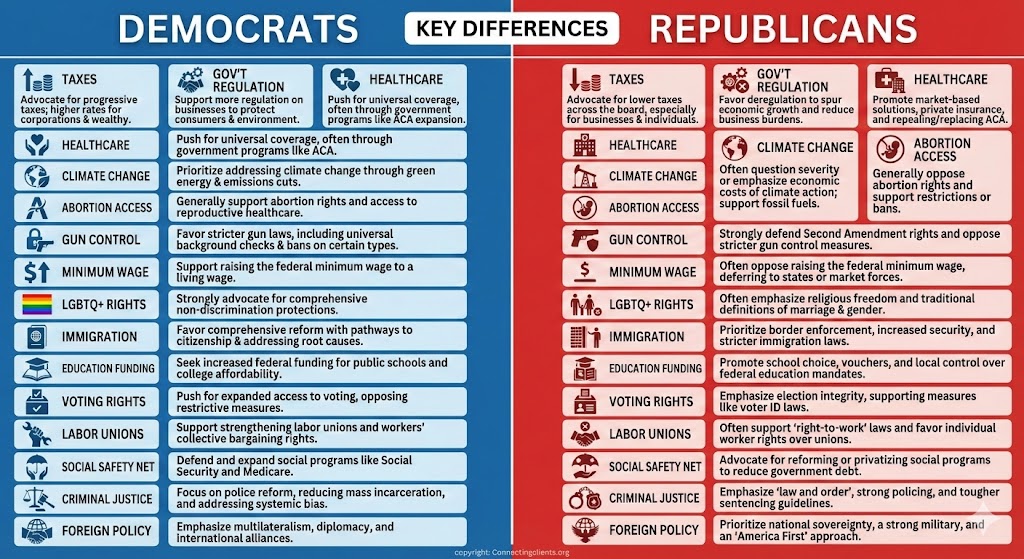
Democrat vs Republican Chart (2025 Quick Comparison)
| Topic | Democrats | Republicans |
|---|---|---|
| Government | Bigger role | Smaller role |
| Taxes | Higher for wealthy | Lower for all |
| Healthcare | Public options | Private market |
| Guns | More restrictions | Fewer restrictions |
| Climate | Urgent crisis | Gradual change |
| Immigration | Citizenship pathway | Strict enforcement |
| Abortion | Legal | Restricted |
| LGBTQ+ | Expanded rights | Traditional values |
| Economy | Regulated | Free market |
| Welfare | Strong programs | Limited programs |
Here are the main 15 Differences Between Democrats and Republicans
1. Role of Government
Democrats (2025):
Believe government should play an active role in solving problems like healthcare, education, and poverty.
Republicans (2025):
Believe government should stay limited, allowing individuals and states to make more decisions.
2025 Polling Insight:
Pew Research shows 68% of Democrats support stronger federal programs, while 72% of Republicans want less federal involvement.
2. Taxes
Democrats:
Support higher taxes on corporations and wealthy individuals to fund social services.
Republicans:
Support lower taxes to promote business growth and economic freedom.
2025 Trend:
Democrats propose new taxes on big tech; Republicans push for nationwide tax cuts.
3. Healthcare
Democrats:
Favor expanded government healthcare — lower drug prices, more public options.
Republicans:
Favor private insurance competition and reducing federal control over healthcare.
2025 Data:
Majority of Democrats support a “Medicare-like public option,” while Republicans oppose it.
4. Climate Change
Democrats:
View climate change as an urgent crisis requiring aggressive policies and renewable energy.
Republicans:
Support energy independence but prefer gradual changes; focus on innovation, not large regulations.
2025 Polls:
85% of Democrats call climate change “major threat.” Only 28% of Republicans agree.
5. Gun Laws
Democrats:
Support universal background checks, red-flag laws, and assault weapon restrictions.
Republicans:
Defend 2nd Amendment rights and oppose most new gun restrictions.
6. Immigration
Democrats:
Favor pathways to citizenship and protections for undocumented immigrants.
Republicans:
Focus on strict border security, deportation for illegal entry, and reduced immigration levels.
7. Abortion
Democrats:
Support legal abortion and reproductive rights.
Republicans:
Oppose abortion in most cases and support state-level restrictions.
8. LGBTQ+ Rights
Democrats:
Support protections for LGBTQ+ individuals, gender identity rights, and anti-discrimination laws.
Republicans:
Support traditional gender definitions; oppose federal mandates on gender policies.
9. Education
Democrats:
Support free community college, student loan forgiveness, and increased federal funding.
Republicans:
Support school choice, homeschooling freedom, and reduced federal control.
10. Economy Approach
Democrats:
Believe the government should reduce inequality through social programs.
Republicans:
Believe the free market drives economic success.
11. Criminal Justice
Democrats:
Support police reform, rehabilitation programs, and reducing prison populations.
Republicans:
Support strong law enforcement and tougher penalties for crime.
12. Voting Laws
Democrats:
Support expanded voting access, mail-in ballots, and automatic voter registration.
Republicans:
Support strict voter ID laws and limits on mail-in voting for security reasons.
13. Foreign Policy
Democrats:
Support diplomacy, global cooperation, and human rights.
Republicans:
Support military strength, strict border protection, and America-first strategies.
14. Social Welfare Programs
Democrats:
Support expanded welfare, food aid, unemployment benefits, and child tax credits.
Republicans:
Support shrinking government programs and encouraging work requirements.
15. Economic Inequality
Democrats:
Believe inequality is a systemic problem the government must fix.
Republicans:
Believe inequality is a natural result of personal freedom and opportunity differences.
Is Trump Republican or Democrat?
Donald Trump is Republican.
He served as a Republican president (2017–2021) and is the leading Republican figure in 2025.
How to Explain Democrat vs Republican to a Child
You can explain the difference simply:
- Democrats = “We share more and solve problems together.”
- Republicans = “People make their own choices with more freedom.”
Both want the country to be better — they just have different ideas.
Republican vs Democrat Quiz
3 quick questions to test your understanding of party differences. Instant feedback and short explanations.
1) Who supports more government involvement?
- Democrats
- Republicans
- Both equally
2) Which party focuses on lower taxes?
- Democrats
- Republicans
- Neither
3) Which party supports more climate action?
- Democrats
- Republicans
- Both equally
Conclusion
Democrats and Republicans both care about America — they just approach problems differently. From government size to the economy, education, and social values, these 15 differences help explain why debates happen and how voters choose sides. By understanding the 2025 positions and polling trends, readers can form clearer, more informed opinions.