How to Explain Democrat vs Republican to a Child (A Complete Parent’s Guide)

Talking about politics with children doesn’t have to feel overwhelming. Kids naturally ask questions about everything they hear—especially during elections, on TV, or in family conversations. Words like Democrat and Republican are confusing to young minds, but with simple language and clear examples, you can explain these concepts in a way they’ll truly understand.
This guide gives parents, teachers, and caregivers an easy, neutral, and age-appropriate way to introduce political parties to kids without stressing them out—or influencing them. Your goal isn’t to make them pick a side.
Your goal is simply to help them understand how democracy works.
What Children Need Before They Learn About Politics
Before explaining political parties, children need three things:
1. A sense of fairness
Kids understand “fair vs unfair” long before “left vs right.” They need to see politics as different ideas—not fights.
2. A basic idea of helping others vs choosing for yourself
This becomes the foundation of understanding the difference between government support and personal responsibility.
3. Reassurance
Children must know:
- No one is bad for having different opinions
- People can disagree and still be kind
- Adults still keep them safe, no matter who gets elected
Once these three ideas are clear, explaining Democrats and Republicans becomes very simple.
The Simplest Way to Explain Political Parties
For a child:
➡️ Political parties are groups of people who share similar ideas about how to solve problems in the country.
➡️ Democrats and Republicans are the two biggest groups.
Both want:
- Safe neighborhoods
- Good schools
- A strong country
- Happy families
They simply have different ways of reaching those goals.
A child-friendly summary:
“Think of it like two groups of helpers. They both want to make the country better, but they have different plans.”
That’s the foundation.
Age-Based Explanations
Kids of different ages understand politics differently. Here’s how to tailor your explanation.
Ages 4–5 (Preschool Level)
Keep it extremely simple.
Example explanation:
“Some people think we should share more, and some people think everyone should choose for themselves. That’s what the two groups believe.”
No labels yet—keep it concept-based.
Ages 6–8 (Early Elementary)
Introduce the words Democrat and Republican.
Example explanation:
“There are two big teams of grown-ups who have different ideas about how to help the country.
- Democrats think the government should help people more.
- Republicans think people should make more decisions themselves.
Both teams want everyone to live a good life.”
Keep it gentle and factual.
Ages 9–11 (Upper Elementary)
Kids can now handle more details.
Example explanation:
“Democrats want the government to provide more programs that help people, like school lunches or health care.
Republicans want the government to stay smaller and let families make more of their own choices with their money.”
This is also a good time to introduce:
- Voting
- Debates
- Responsibility
- Respectful disagreement
Ages 12+ (Middle School and Up)
They can now understand systems, patterns, and values.
Example explanation:
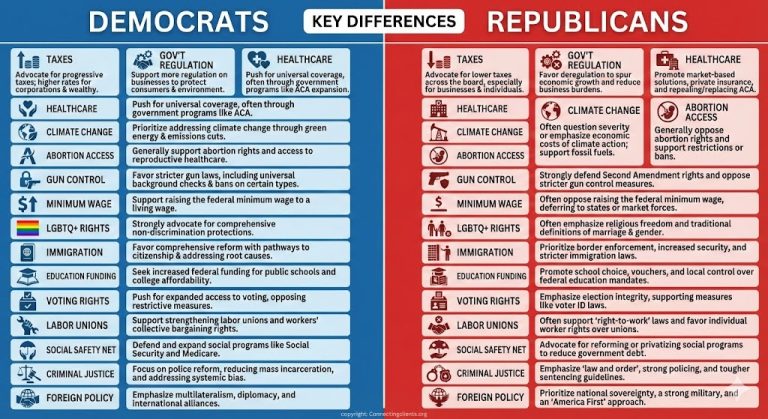
“Democrats prioritize community support, social programs, and shared resources.
Republicans prioritize personal responsibility, economic freedom, and individual choice.
Neither is completely right or wrong—they just focus on different things.”
This age is also ready for:
- Bias awareness
- Media literacy
- Civil discussion skills
Use a Team Analogy (Kids Understand This Immediately)
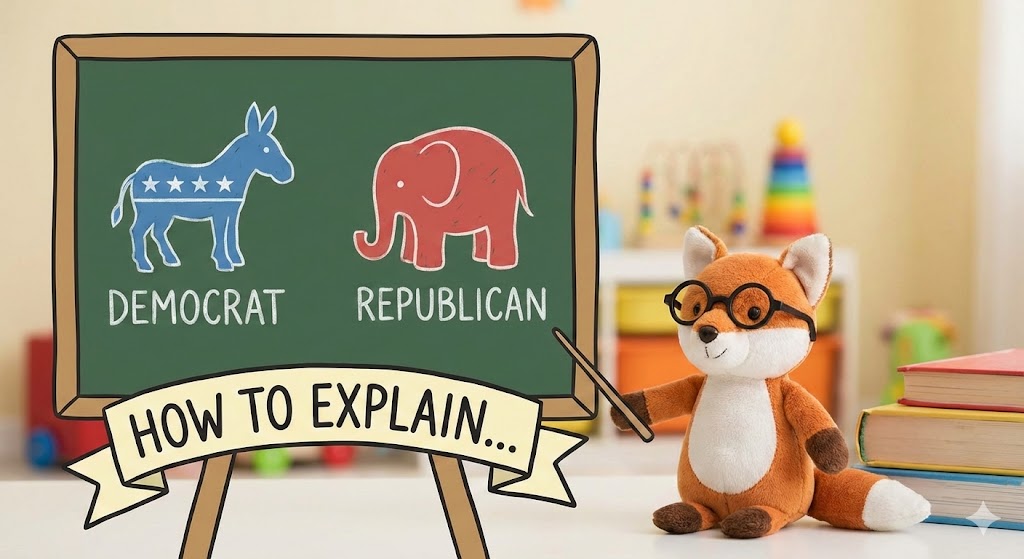
Children understand teams better than political systems.
A perfect analogy is:
“Imagine two sports teams. Both want to win the game and make their fans proud.
They just use different strategies.”
Team Colors
- Democrats = Blue
- Republicans = Red
Team Playbooks
- Democrats prefer teamwork approaches like sharing resources
- Republicans prefer strategies that give individuals the most freedom
Fans Choose Their Team
This represents voting.
The Teams Aren’t Enemies
This is essential.
They’re competitors—not villains.
When kids see political parties as teams, fear and confusion disappear.
Core Beliefs Explained in Kid-Friendly Language
Here is the simplest possible explanation:
Democrats
- Want the government to help people who need support
- Believe in sharing resources
- Think community programs make life fairer
- Prefer rules that protect people
- Want everyone to have equal opportunities
Kid example:
“Like when a teacher gives supplies to kids who don’t have any.”
Republicans
- Want people to make their own choices
- Believe families know what’s best
- Feel people should keep more of the money they earn
- Prefer fewer government rules
- Value personal responsibility and independence
Kid example:
“Like when parents give you allowance and let you decide how to use it.”
Friendly Table for Children
| Democrat Ideas | Republican Ideas |
|---|---|
| Government helps people | Families make their own choices |
| Share resources | Keep what you earn |
| Strong community support | Personal responsibility |
| More government programs | Smaller government |
The key message: Both want America to be strong—they just choose different paths.
Connecting Ideas to Everyday Life (Kids LOVE This)
Children understand politics best through real situations they already know.
Here are perfect kid-based comparisons:
School Supplies
- Democrats: The school provides supplies for everyone
- Republicans: Families buy their own supplies and pick what they want
Playground Toys
- Democrats: Shared community toys
- Republicans: Bring-your-own toys and take care of them
Snack Time
- Democrats: School provides snacks so no one goes hungry
- Republicans: Families choose snacks for their kids individually
Group vs Individual Project
- Democrats: Team-based work and shared results
- Republicans: Individual grades for individual effort
Each example makes the concepts concrete for kids.
Explaining Voting Like a Classroom Decision
Children vote all the time without realizing it—choosing a game, picking a class monitor, deciding on a movie.
Use this analogy:
“Imagine your class wants to pick a game.
Some kids want tag, others want hide-and-seek.
Everyone raises their hand to vote, and the game with the most votes wins.”
That’s exactly how elections work.
Key Rules You Can Tell Kids
- Every person gets one vote
- Most votes win
- Adults choose leaders this way
- You may not always get your choice—but that’s okay
- You get another chance next time
This teaches fairness and participation.
How to Stay Neutral and Positive
Children copy your tone more than your words.
If you sound angry or biased, they will think one party is “bad.”
Here’s how to stay neutral:
Use phrases like:
- “Some people think…”
- “Another group believes…”
- “Both have good ideas, just different ones.”
- “There isn’t one perfect answer.”
Avoid:
- “That party is wrong.”
- “These people don’t care.”
- “Our side is the only good one.”
Your child should walk away with:
- Respect for different opinions
- A sense of fairness
- Curiosity, not fear
What Not to Do When Explaining Politics
Many parents unintentionally confuse kids.
Avoid these mistakes:
1. Don’t make villains out of anyone.
Kids think in black-and-white.
Avoid “good guys vs bad guys.”
2. Don’t overload them with adult topics.
Keep it simple. No taxes, no budgets, no complex laws.
3. Don’t show political anger.
Kids become anxious when adults argue.
4. Don’t force them to agree with you.
Let them form ideas slowly.
5. Don’t shame their questions.
Even “silly” questions are valid.
A Short, Simple History of Democrats and Republicans
Children don’t need the full timeline—just the major points.
The Democratic Party
- Started in the 1820s
- Began as a party for farmers and working people
- Changed during the Great Depression (1930s) to support government programs
- Today focuses on community support, equal rights, and helping people who need extra assistance
The Republican Party
- Formed in 1854
- Abraham Lincoln was the first Republican president
- Focused on ending slavery and promoting industry
- Today supports smaller government, lower taxes, and traditional values
How Both Parties Have Changed
- Their ideas evolved over time
- People from every background join both parties
- The U.S. benefits from many viewpoints—not just one
This helps kids see politics as something living, changing, and flexible.
Real Conversation Scripts You Can Use
Script 1: When Your Child Asks, “What is a Democrat?”
“A Democrat is someone who thinks the government should help people more—like sharing supplies so everyone has what they need.”
Script 2: When They Ask, “What is a Republican?”
“A Republican is someone who thinks people and families should make their own choices without many rules from the government.”
Script 3: When They Ask, “Who is right?”
“Both groups want good things. They just have different ideas about how to solve problems.”
Script 4: When They Hear Arguing on TV
“Those people are discussing their ideas loudly, but that doesn’t mean one side is bad. Adults sometimes argue because they care a lot.”
Script 5: When They Ask, “Can friends have different opinions?”
“Absolutely. People can disagree and still be kind. That’s part of living in a big country.”
Frequently Asked Questions
1. What’s the simplest difference between Democrats and Republicans?
Democrats want more government help. Republicans want more personal choice.
2. Which party is better for kids to support?
Neither. Kids don’t need to choose a party.
3. How can I stay neutral?
Present facts equally and avoid emotional language.
4. What age should I start explaining politics?
Around 6–8, depending on curiosity.
5. Can people from different parties be friends?
Yes, absolutely.
6. Why do adults get upset during elections?
Because they care deeply about the country’s future.
7. Do kids vote?
Not yet—but school elections teach them how.
8. Are Democrats and Republicans the only parties?
No, but they are the two biggest ones.
9. Do political parties ever change their ideas?
Yes. Parties evolve as the world changes.
10. Why do people disagree so much?
Because they have different experiences, needs, and priorities.
Conclusion
Explaining Democrats and Republicans to a child doesn’t have to be complicated.
With the right analogies—teams, classrooms, toys, allowances—you can turn unfamiliar political concepts into simple, familiar ideas.
Remember the keys:
- Keep it simple
- Stay neutral
- Use everyday examples
- Stay positive
- Encourage curiosity
By teaching your child how politics works in a calm and balanced way, you’re helping them grow into thoughtful, respectful, and informed future citizens.
And that is one of the best gifts you can give them.